The project

Scalable solutions optimisation and decision tool creation for low impact SAF production chain from lipid-rich microalgae strain is a Horizon Europe Research and Innovation Action project that will contribute to support third generation biofuels growth

The concept

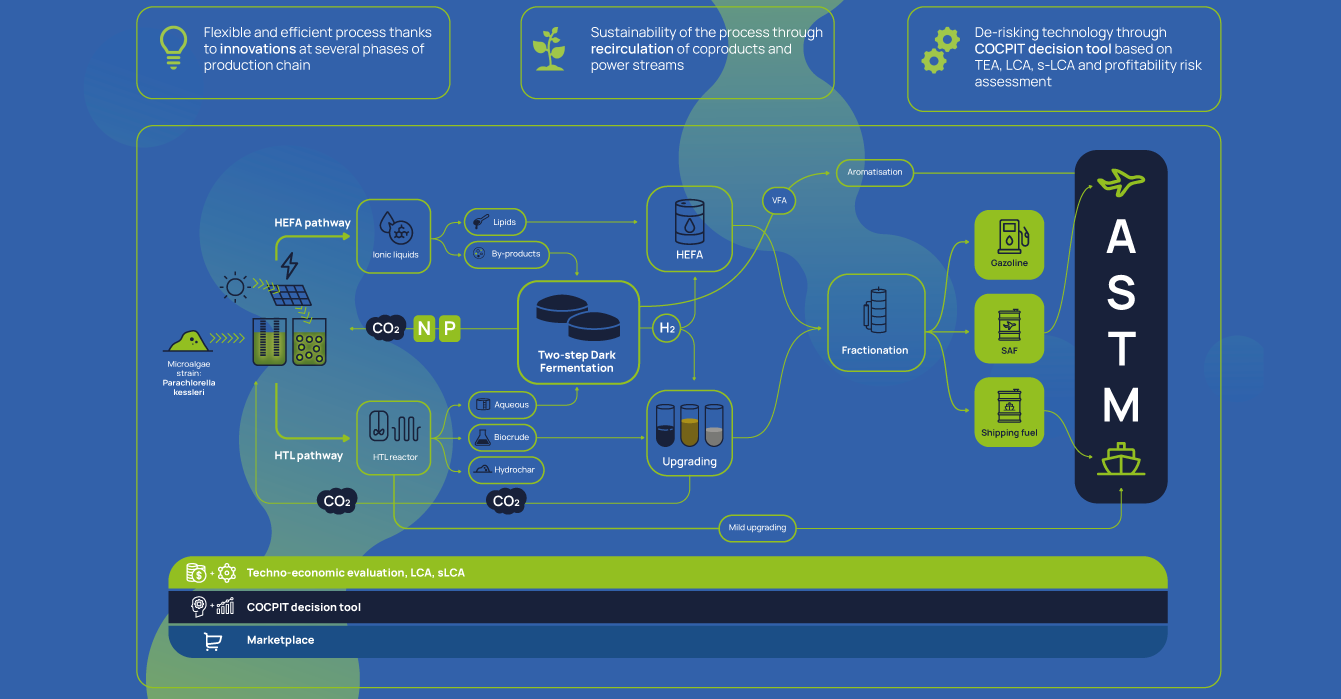
The process originates with microalgae cultivation in photobioreactors (PBRs) covered with semi-transparent photovoltaic (STPV) shell and develops along two possible pathways (HEFA, hydrotreated esters and fatty acids and HTL, hydro-thermal liquefaction), valorising by-products and power streams and finally producing aviation and shipping fuels that comply with American Society for Testing and Materials (ASTM) standards.
Based on economic, social and environmental indicators, COCPIT decision tool will analyse different prospective scenarios and it will be available to end-users on a comprehensive marketplace, together with a full range of algae fuel technological solutions.
cocpit-infographic

COCPIT approach based on three pillars

  • Increase microalgae feedstock for sustainable fuels production by coupling algae cultivation in photobioreactor with semi-transparent photovoltaic (STPV) shell.
  • Design of a novel hydro-thermal liquefaction (HTL) reactor fully tailored for sustainable aviation fuel (SAF) production.
  • Maximum drop-in SAF production thanks to catalytic hydrotreatment able to reduce nitrogen content.
  • Ionic Liquid (IL)-based separation method to enhance lipid extraction from microalgae.
  • Aromatics production to improve SAF properties, delivering fuels that can be blended at high rates.
    Ionic Liquid (IL)-based catalysts to deliver a cost-effective hydrotreated esters and fatty acids (HEFA) process.
  • Optimise SAF production from hydro-thermal liquefaction (HTL) followed by upgrading to ensure high quality, low costs and low environmental footprint.
  • Enhance value chain recirculating CO₂ and nutrients and by recovering H₂ from the organic by-products of hydrotreated esters and fatty acids (HEFA) and hydrothermal liquefaction (HTL) pathways.
  • Use of dark fermentation to valorise byproducts producing hydrogen for fuel refining purpose, aromatics as fuel boosters and recirculating nitrogen and phosphorus to the photobioreactor.
  • Exploit process design simulation to estimate mass and energy inventories and process equipment sizing for alternative conversion routes to develop integrated sustainability and profitability risk assessments.
  • Deliver a decision tool based on knowledge and expertise developed in process design, techno-economic assessment (TEA), life-cycle assessment (LCA) and social life-cycle assessment (s-LCA) and profitability risk assessment to facilitate the selection of the most relevant conversion pathway for sustainable fuels production

COCPIT support the following UN Sustainable Development Goals (SDGs):

Delivering low-emissions biofuels reduces their exposure to humans

Optimizing the system and related production costs, while implementing circularity and reducing consumption

Optimizing the system and related production costs, while implementing circularity and reducing consumption

COCPIT medium-long term impacts: